MATH 1040 - Introduction to Statistics
Lesson 11.2 Factorials
Reading
Reading sections are from the Introductory Statistics Textbook
- 7.1.1 —
Lesson
In the last lesson (11.1 Fundamental Counting Rule), we saw one example of 13 runners in a race. We saw the following:
- There are 13 different contestants who can place 1st.
- There are 12 different contestants who can place 2nd (all but the 1st place contestant).
- There are 11 different contestants who can place 3rd (all but the 1st and 2nd place contestants).
- There are 10 different contestants who can place 4th (all but the 1st, 2nd, and 3rd place contestants).
- There are 9 different contestants who can place 5th (all but the 1st, 2nd, 3rd, and 4th place contestants).
- There are 8 different contestants who can place 6th (all but the 1st - 5th place contestants).
- There are 7 different contestants who can place 7th (all but the 1st - 6th place contestants).
- There are 6 different contestants who can place 8th (all but the 1st - 7th place contestants).
- There are 5 different contestants who can place 9th (all but the 1st - 8th place contestants).
- There are 4 different contestants who can place 10th (the last 4 runners).
- There are 3 different contestants who can place 11th (the last 3 runners).
- There are 2 different contestants who can place 12th (the last 2 runners).
- There is only 1 contestant who can place 13th (the last runner).
So, following the Fundamental Counting Rule, the number of possible arrangements that the runners can cross the finish line is,
\[13\times 12\times 11\times 10\times 9\times 8\times 7\times 6\times 5\times 4\times 3\times 2\times 1 = \mathbf{6,227,020,800}\]This type of calculation where you multiple all numbers from 1 through a number \(k\) is very common, so it is given a notation called a factorial and is indicated as \(k!\).
- 2! = \(1\times 2\) = 2
- 3! = \(1\times 2\times 3\) = 6
- 4! = \(1\times 2\times 3\times 4\) = 24
- 5! = \(1\times 2\times 3\times 4\times 5\) = 120
- …
Practice
Find the value of the following factorials.
Practice Problem 11.2.1
Calculate the value of 9!
After solving on your own, check the solution.
Practice Problem 11.2.2
Calculate the value of 15!
After solving on your own, check the solution.
Practice Problem 11.2.3
Calculate the value of \(\frac{7!}{4!}\).
After solving on your own, check the solution.
Technology
Below are instructions for finding these calculations using various technologies
TI-83/84
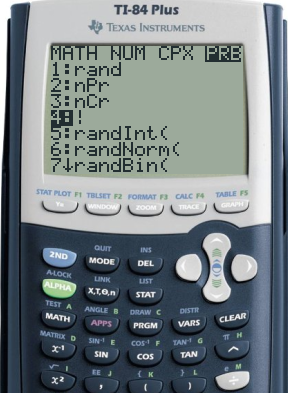
If you are calculating 7! on a TI-83/84, do the following
- Type the value
MATH- Push the right arrow to the
PRBsection for probability functions - Select
4:! - Press Enter to have the (!) appear on the home screen
- Press Enter again to calculate

Excel
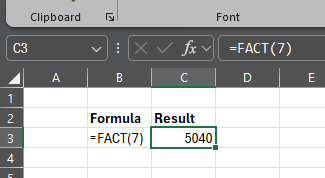
To calculate 7! on Microsoft Excel,
- Select the desired cell
- Type
=FACT(7) - Press Enter
Desmos
- Open desmos.com/calculator or any other Desmos app
- Select a cell
- Type the factorial directly as
7! - The answer will appear on the right side of the cell