MATH 1040 - Introduction to Statistics
Lesson 11.4 Combinations
Reading
Reading sections are from the Introductory Statistics Textbook
- 3.3 The Binomial Formula (pages 110-115)
Lesson
With permutations (lesson 11.3), we saw how to calculate the number of ways we can arrange a selection of participants. Specifically, we looked at how 13 runners could place in first, second, and third places.
In this lesson, we do the same, but say that the order does not matter. Let’s say that, for example, our 13 runners are running a qualifying race instead of the final. The only thing that matters is that the runner is one of the top 3 to qualify (the order does not matter).
If runners A, B, and C qualify, they can finish in any order:
- ABC, ACB
- BAC, BCA
- CAB, CBA
There are six ways to organize 3 runners. All six of these options mean the same thing, so we will divide our permutation by 6 to eliminate these duplicate results. (We’ll do this in a second.)
But notice that 3! = 6. Does this work if we take the top 4 runners instead? If the qualifying runners are A, B, C, and D, then the order can be,
- ABCD, ABDC, ACBD, ACDB, ADBC, ADCB
- BACD, BADC, BCAD, BCDA, BDAC, BDCA
- CABD, CADB, CBAD, CBDA, CDAB, CDBA
- DABC, DACB, DBAC, DBCA, DCAB, DCBA
This makes \(4\times 6 = 24\) different arrangements. Notice that this is \(4\times 3! = 4!\). So, again we divide by 24 (or by \(4!\)).
We call this a Combination. A Combination is the number of ways to select r items from a pool of n. To calculate it, we take our permutation equation and divide by r!.
\[{}_nC_r = \frac{n!}{r!(n-r)!}\]Think of it this way:
- The \(n!/(n-r)!\) counts the arrangements of the first r places (our permutation)
- Dividing by \(r!\) eliminates duplicate arrangements when the order doesn’t matter (ABC vs. CBA)
Another way commonly used to write this (including in your textbook) is,
\[\begin{pmatrix}n \\ r\end{pmatrix} = {}_nC_r = \frac{n!}{r!(n-r)!}\]We often say this as “n Choose r”.
Back to our runners example, how many ways can 3 people from a 13-runner race qualify for the final round? We have 13 runners, and we are choosing 3. So, 13 Choose 3 is the number of permutations (\({}_{13}P_3 = 1716\)) divided by the number of ways they can be rearranged (\(3! = 6\)), which gives 286 different combinations:
\[\begin{align*} {}_{13}C_3 &= \frac{13!}{3!(13-3)!} \\ &= \frac{13!}{3!10!} \\ &= \frac{13\times 12\times 11\times 10\times 9\times 8\times 7\times 6\times 5\times 4\times 3\times 2\times 1}{~~~(3\times 2\times 1)\times(10\times 9\times 8\times 7\times 6\times 5\times 4\times 3\times 2\times 1)} \\ &= \frac{13\times 12\times 11}{3\times 2\times 1} \\ &= \frac{\mathbf{1716}}{6} \tag{Permutation of 1716, which can be arranged in 3! = 6 ways}\\ &= \mathbf{286} \end{align*}\]Said in simpler terms, there are 1716 ways that 3 runners can finish in first, second, and third places, and 6 ways that those same 3 finishers can be rearranged if the order doesn’t matter. So there are 1716/6 = 286 combinations in which 3 runners can qualify from the race.
Let’s now revisit the music example we also saw in the lesson 11.3:
A radio DJ has 15 special new songs and wants to choose 6 of them to play during a special segment of a program. The music is background music, so the order in which the songs are played does not matter. How many combinations of 6 songs are possible?
- There are 15 songs (\(n=15\))
- We are selecting 6 songs (\(r=6\))
- The rest of the songs (\(n-r = 15-6 = 9\)) are unnecessary
- There are 6! = 720 ways the 6 selected songs can be arranged
Let’s solve this logically first, then I’ll show the full math.
- From the Fundamental Counting Rule, there are \(15\times 14\times 13\times 12\times 11\times 10 = 3,603,600\) ways to select 6 songs
- There are \(6! = 720\) ways to arrange the 6 songs
- To remove duplicates (ABCDEF vs. FEDCBA), we divide: \(3,603,600 / 720 = 5,005\)
So, there are 5,005 different combinations of 6 songs from our pool of 15 songs.
Now, let’s look at the full math to see if it agrees:
\[\begin{align*} {}_{15}C_{6} &= \frac{15!}{6!(15-6)!} \\ &= \frac{15!}{6!9!} \\ &= \frac{15\times 14\times 13\times 12\times 11\times 10\times 9\times 8\times 7\times 6\times 5\times 4\times 3\times 2\times 1}{~~~~~~~~~(6\times 5\times 4\times 3\times 2\times 1)\times(9\times 8\times 7\times 6\times 5\times 4\times 3\times 2\times 1)} \\ &= \frac{15\times 14\times 13\times 12\times 11\times 10}{6\times 5\times 4\times 3\times 2\times 1} \\ &= \frac{3,603,600}{720} \tag{These are the numbers we saw solving it logically} \\ & = \mathbf{5,005} \end{align*}\]Practice
Take the same 3 practice problems as we saw in 11.3 on Permutations. Let’s do them again, but making the order irrelevant.
Practice Problem 11.4.1
You’re visiting a city with 7 major tourist attractions, and you only have time to visit 3 of them in one day. You want to plan the order in which you’ll visit them to make the most of your experience. You plan to spend equal time at each site, so the order doesn’t matter. How many options do you have for choosing 3 attractions?
After solving on your own, check the solution.
Practice Problem 11.4.2
A business has 9 applicants for 2 job openings, both as managers. How many ways can the business select 2 new employees out of the 9 candidates?
After solving on your own, check the solution.
Practice Problem 11.4.3
An emergency room receives 8 patients after a multi-vehicle accident. Due to limited resources, only 5 trauma bays are immediately available for treatment. Assume the severity of the injuries is about the same for each patient. In how many different ways can the ER staff choose and prioritize 5 patients out of the 8 for immediate treatment?
After solving on your own, check the solution.
Technology
Below are instructions for finding these calculations using various technologies
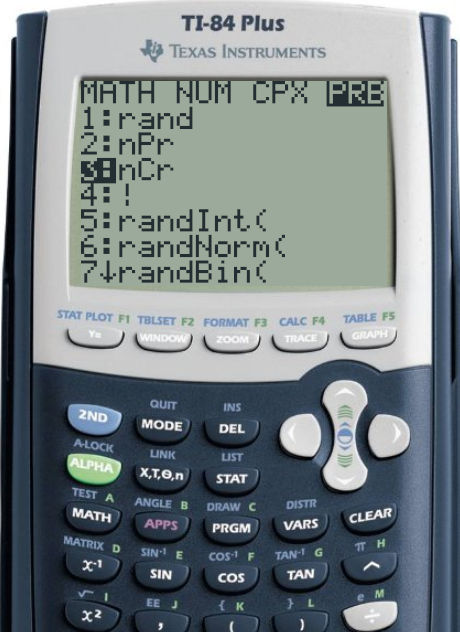
TI-83/84
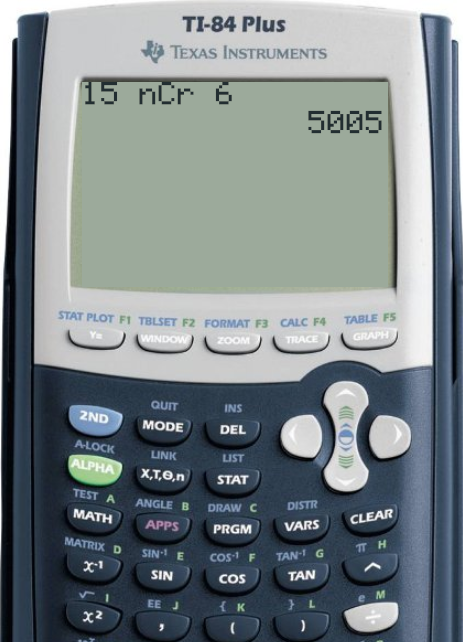
To calculate ${}_{15}C_6$,
- Type
15(The total number of items) - Select
MATH - Push the right arrow to the
PRBsection for probability functions - Select
3:nCr - Press Enter to have the (nCr) appear on the home screen
- Type
6(The desired number of items to select) - Press Enter again to calculate
Excel
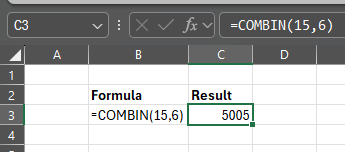
To calculate ${}_{15}C_6$ on Microsoft Excel,
- Select the desired cell
- Type
=COMBIN(15,6) - Press Enter
Desmos
To calculate ${}_{15}C_6$,
- Open desmos.com/calculator or any other Desmos app
- Select a cell
- Type
nCr(15,6) - The answer will appear on the right side of the cell
