MATH 1040 - Introduction to Statistics
12.2 Distributions
Reading
Reading sections are from the Introductory Statistics Textbook
Having learned about probability distributions, let’s take a look at a few different distributions that we have or will learn about.
Uniform
The most basic distribution is a uniform distribution. In this distribution, all categories have the same probability.
- Show a table and a graph of a uniform probability distribution
Normal Distribution
The distribution that is most useful in statistics is the normal distribution. This is most important as we get into the last half of the course.
A normal distribution is characterized with a high probability in the center. This center marks the mean, median, and mode of the data (see Lesson 6 on Measures of Center). The probabilities taper to lower probabilities as the data gets further from the mean.
- Show a graph of a normal probability distribution
We’ll study more about normal distributions after the midterm exam.
Skewed (Left or Right)
A left-skewed distribution is almost a normal distribution, but have extra data left of the mode, thus shifting the mean and median to the left.
- Show a graph of a left-skewed distribution
A right-skewed distribution is almost a normal distribution, but have extra data right of the mode, thus shifting the mean and median to the right.
- Show a graph of a right-skewed distribution
Binomial
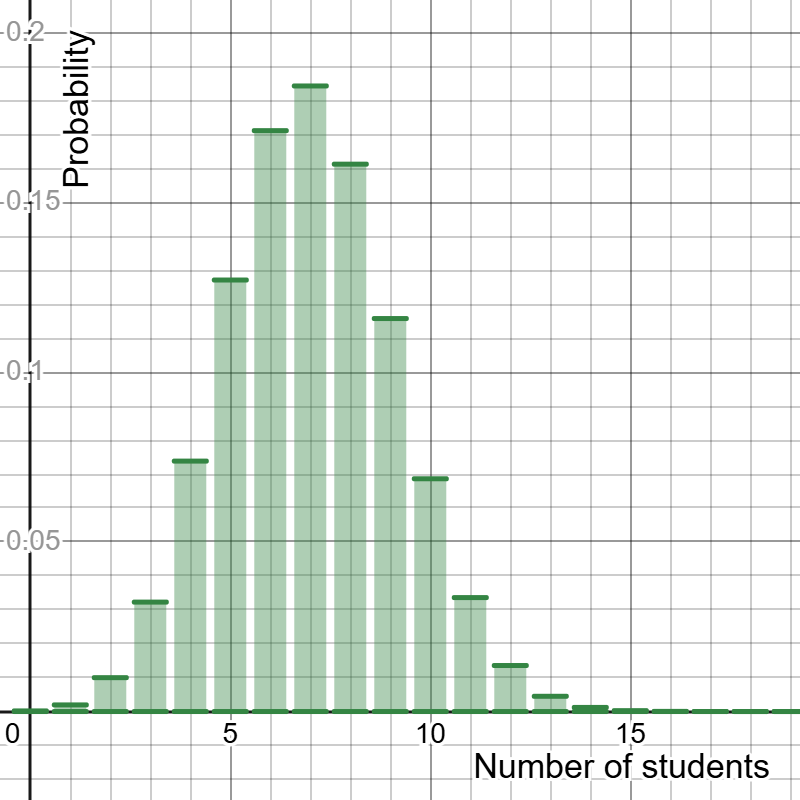
The next distribution we will be discussing (Lessons 13-14) is the binomial distribution. This is characterized by only having two possible outcomes - either a success or a failure. For example, let’s say that 35% of students at a particular school are involved with sports. If we want to study how many students play sports by taking a sample of 20 students, the binomial distribution shows,
- the probability that 1 of the 20 students plays a sport is 0.02%
- the probability that 2 of the 20 students plays a sport is 1.00%
- the probability that 3 of the 20 students plays a sport is 3.23%
- the probability that 4 of the 20 students plays a sport is 7.38%
- etc.