MATH 1040 - Introduction to Statistics
Lesson 18.2 Margin of Error
Reading
Reading sections are from the Introductory Statistics Textbook
- 7.1.1 Using the z-distribution for inference when \(\mu\) is unknown and \(\sigma\) is known (pages 277)
Lesson
In lesson 18.1, we found the critical values of a specified critical level.
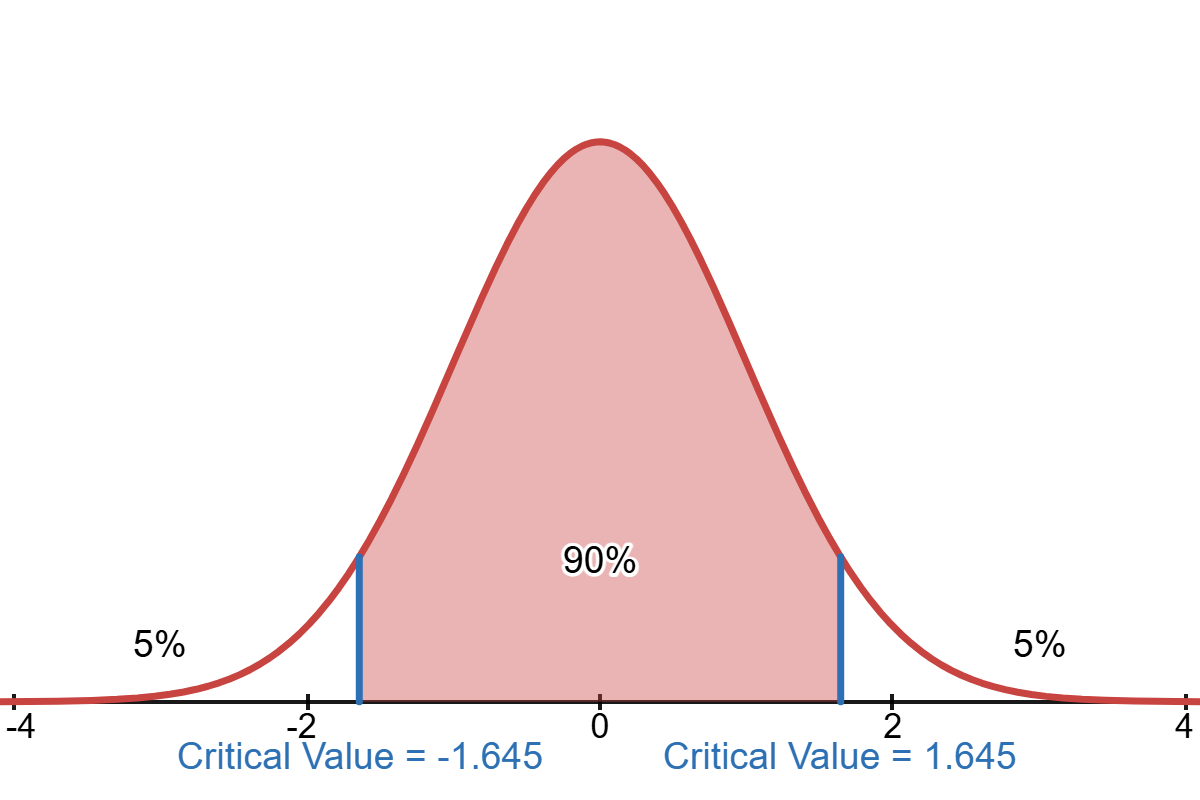
We take these critical values and convert them back to our regular scale to find the boundaries of our confidence interval.
Recall that the equation for finding a z-score is,
\[z = \frac{x-\mu}{\sigma}\]We need to make two changes. Since we are applying the Central Limit Theorem, we are going to use our mean and standard deviation from our sampling distribution:
\[z = \frac{\bar{x} - \mu_{\bar{x}}}{\sigma_{\bar{x}}} = \frac{\bar{x}-\mu}{\tfrac{\sigma}{\sqrt{n}}}\]Since we are after the population mean, we solve for \(\mu\).
\[\pm z\frac{\sigma}{\sqrt{n}} = \bar{x}-\mu\] \[-\bar{x} \pm z\frac{\sigma}{\sqrt{n}} = -\mu\] \[\mu = \bar{x} \pm z\frac{\sigma}{\sqrt{n}}\]This is our confidence interval! The population mean (the true value) is most likely between \(\bar{x} - z(\sigma / \sqrt{n})\) and \(\bar{x} + z(\sigma / \sqrt{n})\). In the next page, we’ll see a full example of this calculation along with how to interpret it.
The last term of this formula is known as the margin of error (\(E\)).
\[E = z\frac{\sigma}{\sqrt{n}}\]Practice
- The average height of a particular species of flower is 5.5 inches with a standard deviation of 0.4 inches. You sample a subspecies and find 49 flowers with a sample mean height of 5.8 inches. What is the margin of error with a 95% confidence level?
- The average length of a particular set of books written by authors around the world is 425 pages with a standard devation of 32 pages. Looking at authors specifically from South Africa, a sample of 36 of these books has an average length of 410 pages. What is the margin of error with a 90% confidence level?
- Bottles of soda are to be filled with 2.00 liters, allowing some room for error giving a standard deviation of 0.15 liters. Calculate the margin of error for a sample of 54 of these bottles with an average volume of 1.95 liters at a 99% confidence level.