MATH 1040 - Introduction to Statistics
Lesson 18.5 Confidence Interval when you don’t know \(\sigma\)
Reading
Reading sections are from the Introductory Statistics Textbook
- 7.1.2 Introducing the t-distribution (pages 278-281)
- 7.1.3 The t-distribution and the standard error of a mean (page 281)
- 7.1.5 One sample t-intervals (pages 282-285)
Lesson
Consider this problem:
A health researcher wants to estimate the average number of hours of sleep that college students get on weeknights. A random sample of 25 students is taken from a normally-distributed population, and the sample yields a mean of 6.8 hours with a sample standard deviation of 1.2 hours.
Construct a 95% confidence interval for the true mean number of hours of sleep college students get on weeknights.
Notice that in this case, we do not have a population standard deviation (\(\sigma\)). So, our Margin of Error calculation won’t work.
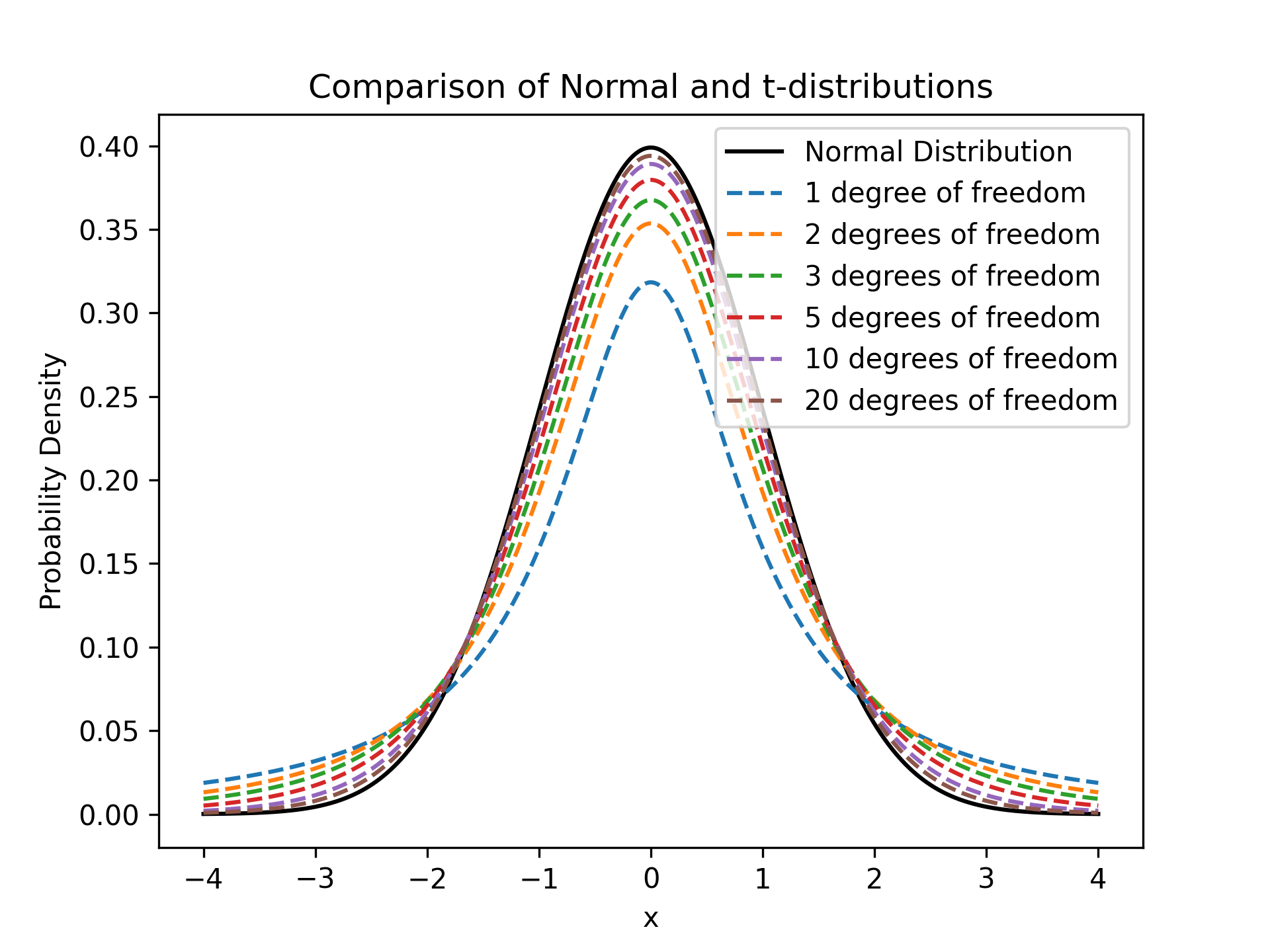
Fortunately, we have a solution. The normal distribution depends on the population. Another distribution that we call the t-distribution depends instead on the sample. This is a good approximation of the normal distribution.
With the t-distribution, we find a critical value from t-scores and use the sample standard deviation to find the margin of error.
\[E = t_c\frac{s}{\sqrt{n}}\]However, since the t-distribution relies on the sample, we also have to consider one more variable:
- The Degrees of Freedom is calculated as \(DF = n-1\)
- As \(n\) increases, the t-distribution becomes a better approximation of the normal distribution.
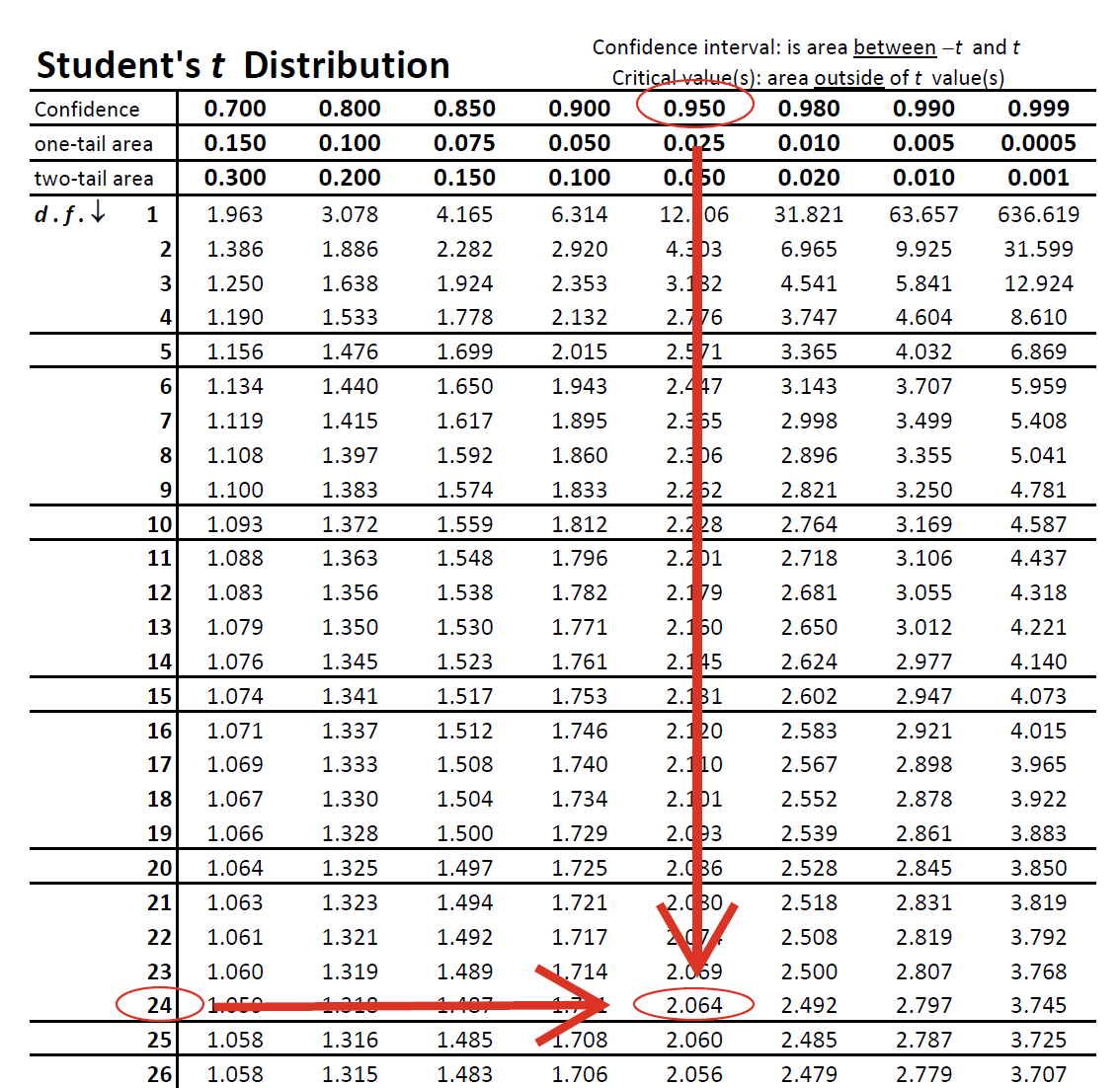
To find the critical t-score, use a T-Table or a calculator (Note that the TI-83 will not work for this step, so be familiar with the table). In the problem above,
- The Sample Size is \(n=25\)
- There are \(DF = n-1 = 24\) degrees of freedom
- The confidence level is 95%
Using these on the T-Table, we get a critical t-score of \(t_c = 2.064\)
Other than that, the calculations for the Margin of Error and the Confidence Interval are exactly the same. \(E = t_c\frac{s}{\sqrt{n}} \qquad \mu = \bar{x} \pm SE\)
Example
Here is the problem from earlier:
A health researcher wants to estimate the average number of hours of sleep that college students get on weeknights. A random sample of 25 students is taken from a normally-distributed population, and the sample yields a mean of 6.8 hours with a sample standard deviation of 1.2 hours.
Construct a 95% confidence interval for the true mean number of hours of sleep college students get on weeknights.
Here is the information given from the problem.
- Confidence Level is 95%
- Sample Size is \(n = 25\)
- Degrees of Freedom is \(DF = n-1 = 24\)
- Sample mean is \(\bar{x} = 6.8\)
- Sample standard deviation is \(s = 1.2\)
Before we do anything, we must verify that the Central Limit Theorem holds.
- Is the sample random? Yes (stated in the problem)
- Is the sample large enough? No (sample size is smaller than 30)
- If it’s not large enough, is the population normally distributed? Yes (stated in the problem)
So, the Central Limit Theorem holds.
Using the T-Table or the TI-84 with a confidence level of 95% and 24 degrees of freedom, we get a critical value of \(t_c = 2.064\).
\[E = t_c\frac{s}{\sqrt{n}} = 2.064\frac{1.2}{\sqrt{25}} = 0.495\] \[\bar{x} + E = 6.8 + 0.495 = 7.295 \approx \mathbf{7.3}\] \[\bar{x} - E = 6.8 - 0.495 = 6.305 \approx \mathbf{6.3}\]Solution: We are 95% confident that the true mean for the number of hours of sleep college students get on weeknights is between 6.3 and 7.3 hours.
Practice
- A nutritionist wants to estimate the average number of cups of coffee consumed per week by graduate students. A random sample of 16 students shows a mean of 9.3 cups with a sample standard deviation of 2.1 cups. Construct a 90% confidence interval for the true mean weekly coffee consumption of graduate students.
- A tech company tests a new phone battery. A sample of 30 phones, coming from a normally-distributed population, shows an average battery life of 22.4 hours with a sample standard deviation of 3.5 hours. Construct a 99% confidence interval for the true mean battery life of the new phone model.
- A professor surveys 41 students about how many hours they studied for the last exam. The sample mean is 14.2 hours, and the sample standard deviation is 4.6 hours. Construct a 95% confidence interval for the true mean number of hours students studied for the exam.
Technology
TI-83/84
Confidence Interval with t-values
STAT–> [TESTS]- 8:TInterval
- Set Input to ‘Stats’
- Add mean, standard deviation, and size of your sample
- Set C-Level to the requested confidence level
- Select ‘Calculate’
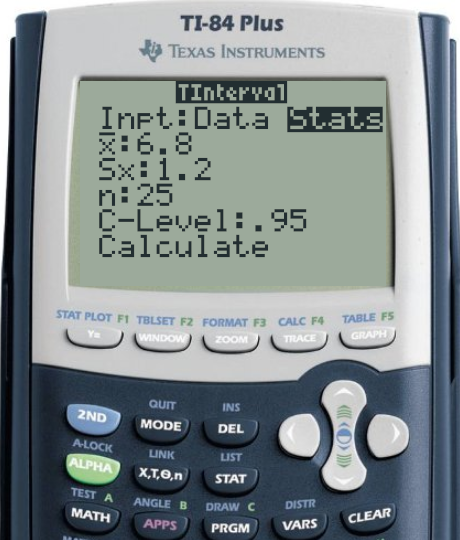
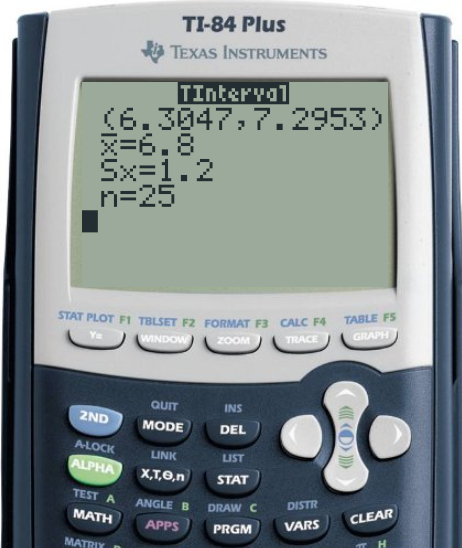
Alternatively, you can set Input to ‘Data’ and add your data to a list. The calculator will calculate the mean and standard deviation for you.
Finding a t-value
Note that this method will not work on the TI-83. Use the T-Table instead.
To find the t-score:
- Find the confidence level and the degrees of freedom
- From the confidence level, find the area of the left tail
- If confidence level is 95%, the remaining 5% is divided between the 2 tails, so the left tail has 2.5%.
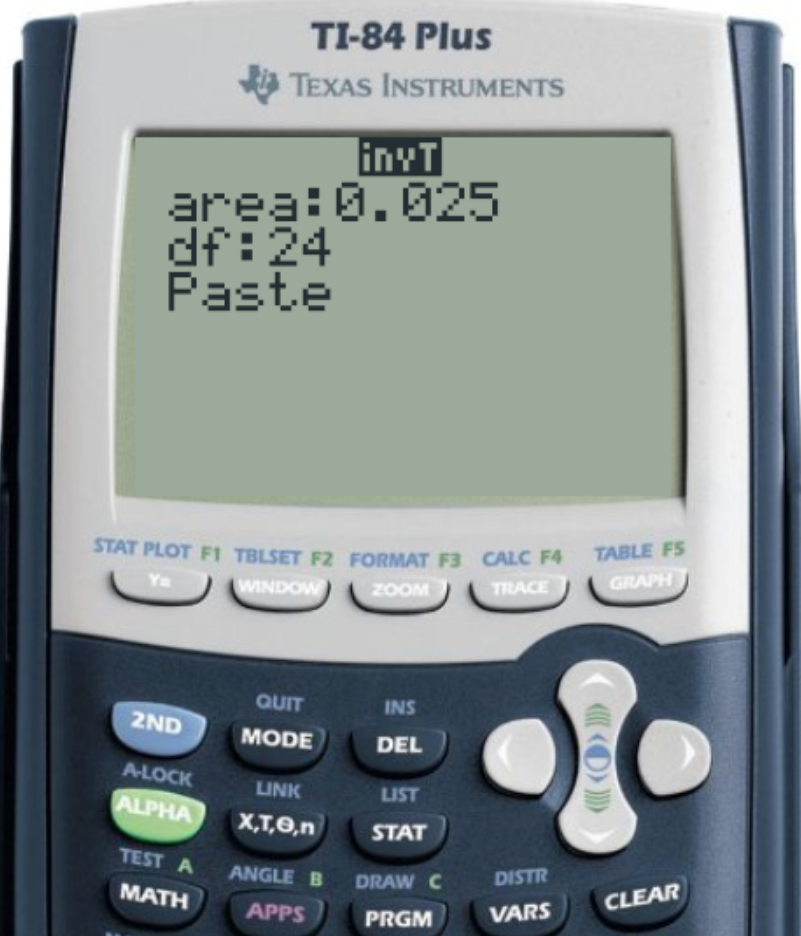
- Press
2nd–>[DISTR] - Select
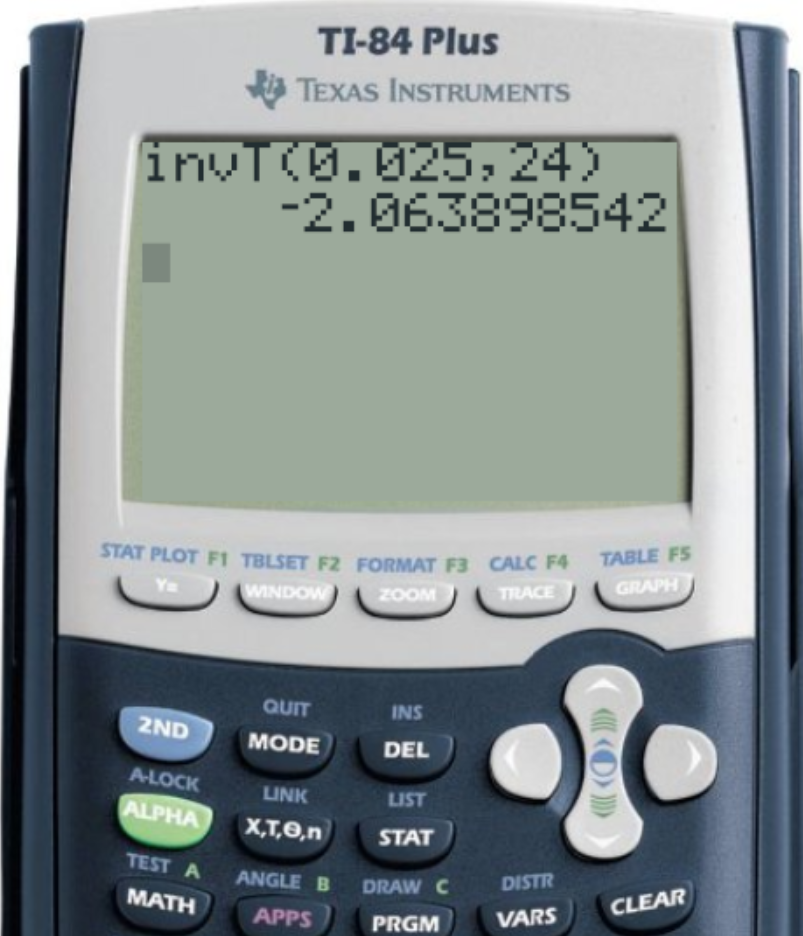
4:invT( - Input the “area” of the left tail
- Input “df” (the degrees of freedom)
- “Paste” and then press “Enter” again